
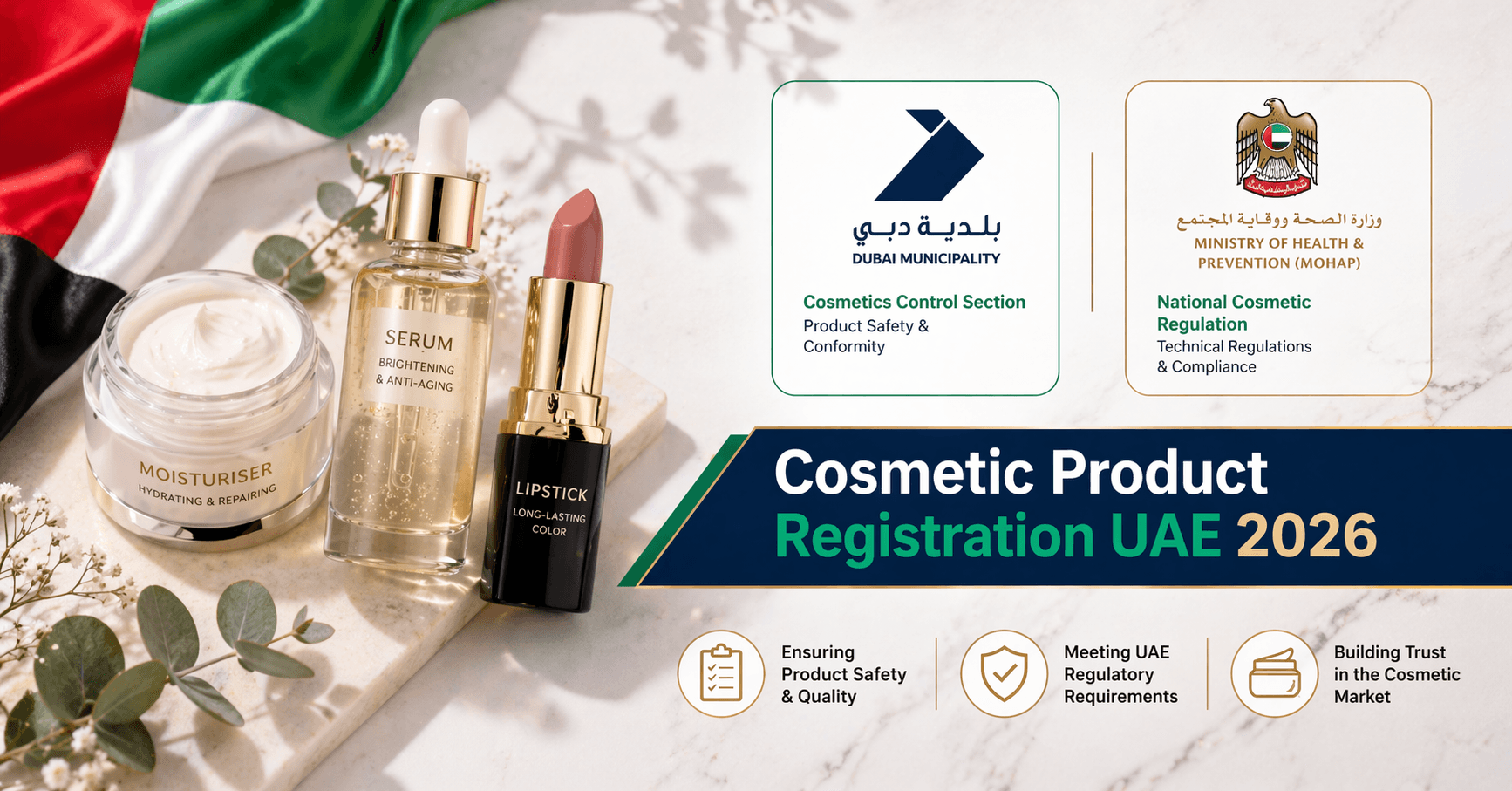
If you want to sell, distribute, or import any health-related product in the UAE, MOHAP registration is not optional — it is a legal requirement. The Ministry of Health and Prevention (MOHAP) is the federal authority that reviews, classifies, and approves every medicine, medical device, health supplement, and cosmetic sold across the UAE.
This guide explains exactly what MOHAP registration involves, who needs it, which products require it, what documents to prepare, how fees and timelines work, and what the most common mistakes are. Whether you are an international brand entering the UAE market or a local distributor adding a new product line, this is the only guide you need.
Who Regulates Cosmetics in the UAE?
The answer depends on how the product is classified. The UAE divides cosmetic products into two broad regulatory pathways:
Product Type | Examples | Regulator |
Standard Cosmetics | Moisturisers, lipsticks, shampoos, perfumes, sunscreens (SPF ≤ 50) | Dubai Municipality (Montaji) |
Medicated / Therapeutic Cosmetics | Anti-dandruff shampoos (active ingredient), acne creams with prescription actives, high-SPF medical sunscreens | MOHAP |
Cosmetics with OTC Drug Claims | Products claiming to treat or prevent a medical condition | MOHAP |
Key Rule: If your cosmetic product makes any therapeutic claim — such as ‘treats eczema’, ‘clinically proven to reduce hair loss’, or ‘relieves skin inflammation’ — it is classified as a medicated product and requires MOHAP registration, not Dubai Municipality registration.
Registering Cosmetics Through Dubai Municipality (Montaji)
For standard cosmetics sold in Dubai, Montaji is your registration platform. The process follows the same steps outlined in our Dubai Municipality guide, with some cosmetic-specific requirements:
Cosmetic-Specific Requirements on Montaji:
- INCI (International Nomenclature of Cosmetic Ingredients) list — all ingredients listed in the internationally recognised INCI format, in descending order of concentration
- Product Function Description — clearly stating the purpose of the cosmetic (e.g., moisturising, cleansing, colouring)
- IFRA Certificate — mandatory for any product containing fragrance or perfume components, certifying the fragrance blend meets International Fragrance Association standards
- Product Safety Assessment Report (PSAR) — required for new formulations entering the UAE market for the first time
- Manufacturer’s Certificate of Conformity — confirming the product meets GMP standards during production
UAE Cosmetic Label Requirements (Arabic + English)
Label compliance is the number one reason cosmetic product registrations are rejected in the UAE. Every label must be bilingual and include all of the following:
Label Element | Specific Requirement |
Product Name | Must appear in both Arabic and English |
Ingredients (INCI List) | All ingredients in Arabic, listed in descending order |
Net Quantity | Volume (ml/l) or weight (g/kg) in Arabic |
Country of Origin | ‘Made in [Country]’ — in Arabic |
Batch Number & Expiry Date | ‘Best before’ or ‘Expiry’ — Arabic text required |
Manufacturer Name & Address | Full legal name and country |
UAE Importer/Distributor Details | Local agent name, address, and contact |
Usage Instructions & Warnings | In Arabic — especially for products with safety precautions |
Halal Symbol (if certified) | Only from ESMA-approved Halal certifying bodies |
Halal Certification for Cosmetics in UAE
While Halal certification is not legally mandatory for all cosmetics in the UAE, it is strongly recommended — and increasingly required by major retailers. The UAE’s Muslim-majority consumer base expects Halal assurance on personal care products, particularly those applied to skin, hair, or lips.
Halal cosmetics must be free from:
- Alcohol derived from fermentation (ethanol used as a solvent)
- Animal-derived ingredients from non-Halal sources (e.g., porcine collagen, non-Halal gelatin)
- Any ingredient derived from blood or carrion
Halal certification for UAE must come from a body accredited by ESMA (Emirates Authority for Standardization and Metrology). Brands certified by internationally recognised bodies may also qualify if their certification is accepted under UAE mutual recognition agreements.
Prohibited Ingredients in UAE Cosmetics
Dubai Municipality maintains a list of prohibited and restricted cosmetic ingredients aligned with Gulf Standards Organisation (GSO) regulations and international cosmetic safety databases. The following ingredient categories are commonly flagged:
- Mercury and mercury compounds — prohibited in all concentrations
- Hydroquinone above 0.5% in leave-on cosmetics
- Certain UV filters not approved by UAE/GSO standards
- Formaldehyde above 0.2% in cosmetics (0.05% in oral hygiene products)
- Steroids and hormones — prohibited in cosmetics; their presence triggers MOHAP classification
How Long Does Cosmetic Product Registration Take?
Standard Montaji cosmetic registration in Dubai takes 4 to 6 weeks with a complete and compliant application. Complex formulations or products requiring additional lab testing may take 6 to 10 weeks. MOHAP registration for medicated cosmetics takes 30 to 60 days.
Nextmove’s typical timeline for cosmetic clients is 3 to 5 weeks from document submission to certificate delivery, as we audit every application before it goes live.
Frequently Asked Questions — Cosmetic Registration UAE
Q1: Can a cosmetic brand from Europe register directly in the UAE?
Yes, but through a UAE-licensed authorised agent. EU-certified cosmetics often have an advantage because UAE standards align closely with EU Cosmetic Regulation EC 1223/2009 — but you still need to provide Arabic labels and a UAE-specific safety assessment for the Montaji submission.
Q2: Do cosmetics need to be tested in the UAE before registration?
Not always. DM accepts safety data and test reports from internationally accredited laboratories. However, DM reserves the right to request local testing for specific product categories. Lab test reports must come from ISO 17025-accredited facilities.
Q3: Is there a minimum shelf life requirement for cosmetics in UAE?
Yes. Products must have a minimum remaining shelf life of at least 12 months at the time of import into the UAE. DM may reject or quarantine products close to their expiry dates.
Q4: Do I need to re-register a cosmetic product if I change its formula?
Yes. Any change to the product formulation, ingredients, fragrance blend, or label triggers a variation notification or a fresh registration in Montaji. Selling under an old registration number after a formulation change is a compliance violation.
Q5: What is a Product Safety Assessment Report (PSAR) and is it mandatory?
A PSAR is a documented evaluation by a qualified cosmetic safety assessor confirming that the product is safe for its intended use at the labelled concentrations. For new product registrations, DM may require it for certain product types. Nextmove can coordinate PSAR preparation through our accredited partner network.