
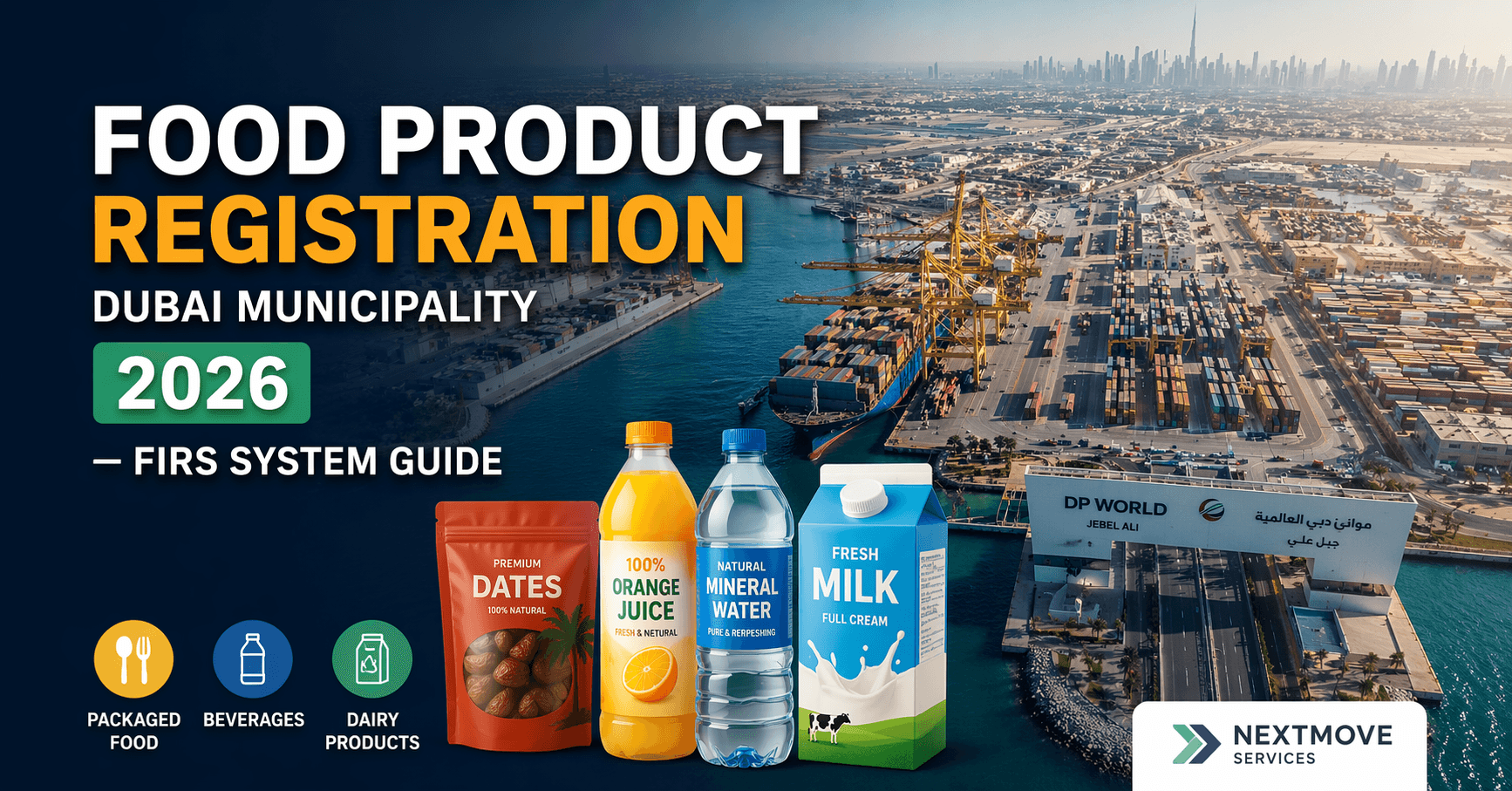
Dubai handles one of the highest volumes of food imports in the world. Millions of tonnes of packaged food, beverages, dairy products, and processed goods pass through Dubai’s ports every year — and every single imported food product must be registered with Dubai Municipality before it can enter the local market.
Unlike cosmetics and supplements which use the Montaji platform, food products go through a separate system called FIRS — the Food Import and Re-export System. This guide explains exactly how FIRS works, what documents are needed, how the lab testing process at Jebel Ali operates, and what you must do to get your food brand legally selling in Dubai.
Why Food Product Registration in Dubai Is Non-Negotiable
Dubai Municipality’s food registration system is one of the most robust in the region. It exists to ensure that every food item on Dubai shelves is safe, accurately labelled, and compliant with UAE and Gulf Cooperation Council (GCC) food safety standards. Without a valid DM food registration, your product:
- Cannot clear Dubai Customs — shipments are held at the port until registration is confirmed or rejected
- Cannot be legally sold in supermarkets, restaurants, or online platforms
- Cannot be re-exported through Dubai to GCC markets as part of a compliant supply chain
- Risks seizure, destruction, and financial penalties for the importer
Registering your food products is not just about compliance — it is the ticket that unlocks Dubai’s position as the GCC’s premier food distribution hub, giving your brand access to over 200 nationalities in one market and re-export routes to Saudi Arabia, Kuwait, Qatar, Bahrain, Oman, and beyond.
What Is FIRS? The Food Import and Re-export System
FIRS (Food Import and Re-export System) is Dubai Municipality’s digital platform for managing food product registrations, import approvals, and re-export documentation. All food importers, manufacturers, and distributors dealing in food products in Dubai must use FIRS.
Through FIRS, a registered business can submit product registration applications, request import permits for shipments, declare re-export consignments, and track the inspection and testing status of food shipments arriving at Dubai ports.
Key difference from Montaji: Montaji handles cosmetics, supplements, and household products. FIRS specifically handles food, beverages, and related consumable products. Using the wrong system will result in your application being rejected outright.
Step-by-Step: Food Product Registration Through FIRS
- Step 1: Get a Valid Trade Licence with Food Trading Activity — Your UAE company must have a food import or food trading activity on its DED trade licence. Without this, you cannot access FIRS or legally import food products.
- Step 2: Register Your Company on FIRS — Access FIRS through the Dubai Municipality e-services portal (dm.gov.ae). Register your company with your trade licence and get a Business Admin User account, similar to the Montaji process.
- Step 3: Product Registration Application — Inside FIRS, create a new product entry for each food item. You will enter the product name, brand, food category, country of manufacture, ingredients, nutritional information, and shelf life details.
- Step 4: Upload Documents — Each product requires: the product label (Arabic and English), ingredient list, Certificate of Analysis (CoA), Halal certificate (if applicable), nutritional analysis report, and Certificate of Conformity. For products containing meat or animal products, additional documents including Halal slaughter certificates and veterinary health certificates are required.
- Step 5: Submit Import Notification — When your food shipment arrives or is ready to ship, you submit an import notification through FIRS. Dubai Municipality will assign an inspection slot.
- Step 6: Jebel Ali Food Safety Laboratory Testing — Dubai Municipality operates food safety laboratories at the Jebel Ali Free Zone. Inspectors may select samples from your shipment for testing. Tests check for microbiological contamination, pesticide residues, heavy metals, food additives levels, and label accuracy. This process typically takes 2 to 5 working days.
- Step 7: ESMA Inspection (for applicable products) — The Emirates Authority for Standardization and Metrology (ESMA) may also conduct inspections for specific product categories, particularly items covered by mandatory UAE technical standards (e.g., bottled water, certain dairy products).
- Step 8: Clearance and Distribution — Once laboratory tests pass and DM approves the import, your goods receive clearance documentation. Products can then be released from the port and distributed to Dubai’s wholesale and retail channels.
Food Product Label Requirements for UAE
UAE food labelling is governed by UAE.S GSO 9:2022 (the Gulf Standards Organisation general labelling standard) along with category-specific standards. Every food label must display:
Label Element | Requirement |
Product Name | In Arabic — clearly identifying the food |
Ingredients List | All ingredients in Arabic, descending weight order |
Nutritional Information Panel | Calories, proteins, fats, carbs, sugar, sodium per 100g/serving |
Allergen Declaration | Bold/highlighted allergens — Arabic required |
Net Weight or Volume | In Arabic — mandatory |
Country of Origin | ‘Product of [Country]’ — Arabic required |
Manufacturing & Expiry Dates | Arabic date format acceptable |
Storage Conditions | Temperature, humidity, or light requirements in Arabic |
Manufacturer Name & Address | Full legal details |
UAE Importer / Distributor | Name and full address in Arabic |
Halal Logo | From DM-approved or ESMA-recognised Halal body |
Barcode / GS1 | GS1-compliant barcode required for retail distribution |
Common Mistakes in UAE Food Product Registration
- Missing Arabic translation on the product label — even imported European brands must add an Arabic sticker/label
- Allergen information not clearly marked in Arabic
- Nutritional panel not meeting the UAE/GSO format (e.g., using US FDA format instead)
- Halal certificate expired or from a non-recognised certification body
- Shelf life below 12 months remaining at time of import
- GS1 barcode not registered — required for retail shelf placement in all major UAE stores
- Meat and poultry products without Halal slaughter certificates from a DM-accepted authority
Frequently Asked Questions — Food Product Registration UAE
Q1: Is food product registration through FIRS mandatory for all food items?
Yes. All food products imported or manufactured for sale in Dubai must be registered through FIRS. There is no category exemption for food products. Consumer food products imported for personal use (not for sale) are not covered, but all commercial quantities require FIRS registration.
Q2: Does organic food need a special registration in UAE?
Organic products must comply with UAE.S GSO 2055 (the organic food standard) in addition to standard food registration requirements. Organic claims on labels must be supported by valid organic certification from an accredited body recognised in the UAE. The word ‘organic’ in Arabic must appear correctly on compliant labels.
Q3: Can I use a European nutritional label format in the UAE?
No. The UAE follows GSO nutritional labelling standards which differ from EU formats. European nutritional panels typically need to be reformatted and translated. The UAE panel must show values per 100g or per serving alongside Recommended Daily Intake (RDI) percentages based on UAE/GSO reference values.
Q4: How long does food product registration take in Dubai?
With complete documentation, FIRS product registration is typically completed in 3 to 6 weeks. Lab testing at Jebel Ali adds 2 to 5 working days per shipment. Halal certificate verification can take an additional 1 to 2 weeks if the certifying body is being checked by DM for the first time.
Q5: Can my food products be sold in other UAE emirates after Dubai Municipality registration?
Dubai Municipality registration covers Dubai only. However, the documentation and standards used for DM registration are closely aligned with Abu Dhabi (ADFCA) and other emirate requirements. Many brands use their Dubai registration package as the foundation for registering across the UAE. Nextmove can manage multi-emirate registration.