
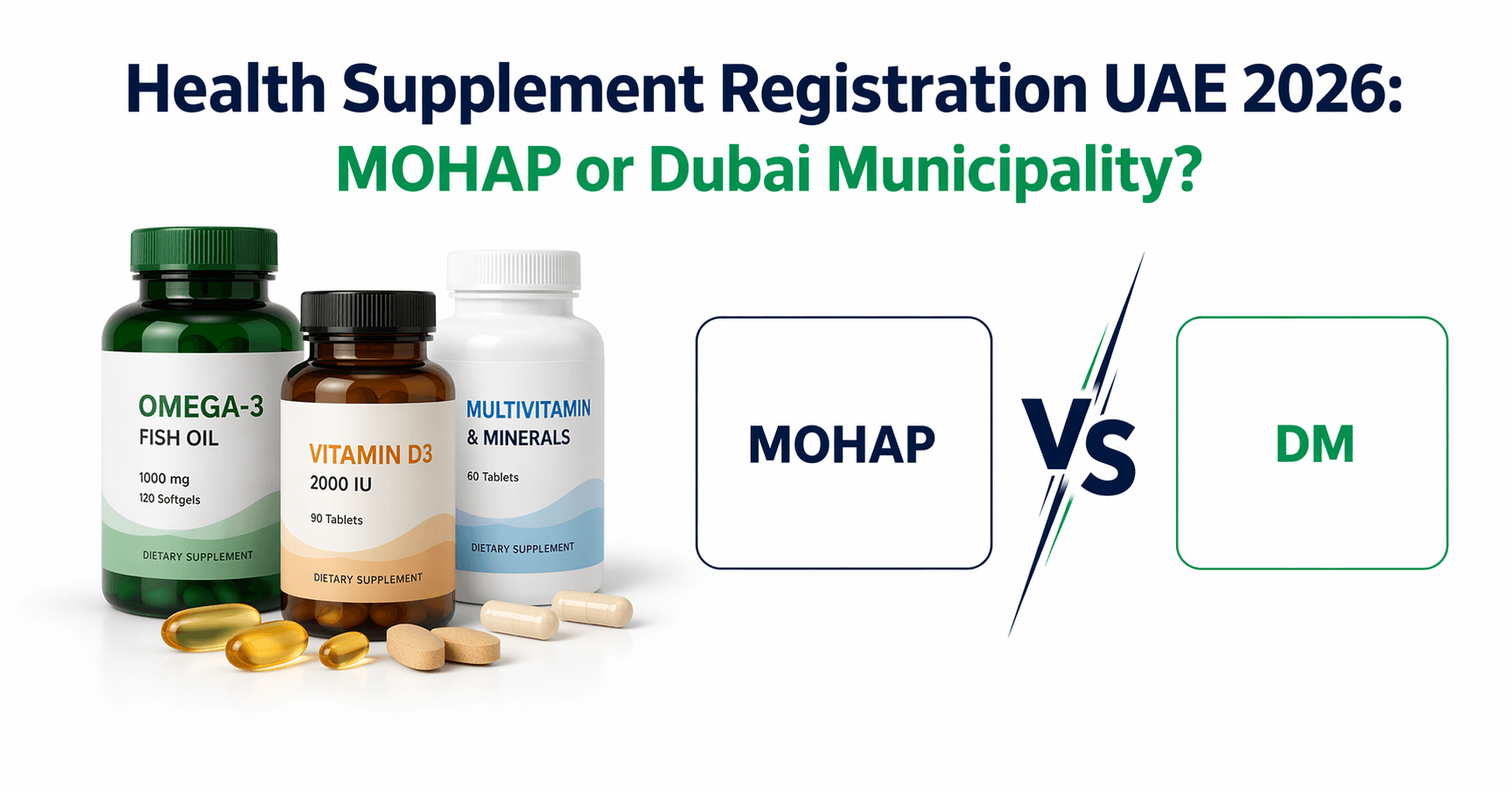
Health supplements are one of the fastest-growing product categories in the UAE, with the wellness market expanding significantly each year. But for importers and brand owners, one question causes more confusion than any other: should your supplement go through MOHAP or Dubai Municipality for registration?
The answer depends entirely on how your product is classified — and getting this wrong means your application goes to the wrong authority, your product sits in a warehouse, and your launch is delayed by months. This guide resolves the confusion clearly and completely.
What Is a Health Supplement Under UAE Law?
A health supplement in the UAE is a product intended to supplement the normal diet. It contains one or more dietary ingredients such as vitamins, minerals, amino acids, herbs, plant extracts, enzymes, or metabolites. It is not intended to treat, cure, diagnose, or prevent any disease.
This definition is critical. The moment a product label or marketing material claims to treat a disease or medical condition, it crosses from supplement territory into pharmaceutical territory — and MOHAP registration becomes mandatory.
MOHAP vs Dubai Municipality — How to Decide Which Applies to Your Supplement
Criteria | MOHAP Registration | Dubai Municipality |
Claims therapeutic benefit | ✅ Yes | ❌ No |
Contains pharmaceutical APIs | ✅ Yes | ❌ No |
Food supplement, dietary only | ❌ No | ✅ Yes |
Vitamins, minerals only | ❌ Mostly No | ✅ Yes |
Sold across all UAE emirates | ✅ Yes | Dubai only |
Registration fee | AED 2,000–6,000 | AED 300–600 |
Timeline | 30–60 days | 4–8 weeks |
UAE Banned and Restricted Ingredients in Health Supplements
The UAE strictly prohibits or restricts a number of ingredients commonly found in supplements sold globally. Selling a supplement with a banned ingredient is a criminal offence. Before registration, always verify your formula against the UAE prohibited list:
- Ephedrine and Pseudoephedrine — banned stimulants found in some pre-workout and weight-loss supplements
- DMAA (1,3-Dimethylamylamine) — prohibited in all supplements in the UAE
- Androstenedione and DHEA — hormonal precursors, prohibited
- Kratom (Mitragyna speciosa) — banned substance in the UAE
- Kava — restricted; requires specific regulatory clearance
- High-dose melatonin (above 1mg) — classified as pharmaceutical in UAE
- Any ingredient derived from prohibited substances under UAE Federal Law No. 14 of 1995
UAE Label Requirements for Health Supplements
Whether registering via MOHAP or Dubai Municipality, supplement labels must comply with UAE.S GSO 9:2022 and specific supplement labelling standards. Every label must include:
Label Element | Specific Requirement |
Product Name & Type | Must state ‘Food Supplement’ or ‘Dietary Supplement’ in Arabic |
Ingredient & Nutrient List | All active and inactive ingredients in Arabic, descending order |
Nutritional Information Panel | RDA (Recommended Daily Allowance) values per serving |
Directions for Use | Dosage instructions clearly in Arabic |
Mandatory Disclaimers | ‘Not a substitute for a varied diet’ — Arabic required |
‘Consult a doctor’ Statement | Mandatory for certain categories and high-dose products |
Net Weight / Volume | In Arabic |
Batch No. & Expiry Date | In Arabic |
Country of Origin & Manufacturer | Full details in Arabic |
UAE Distributor Details | Name and contact in Arabic |
Halal Statement (if certified) | From ESMA-approved body only |
Prohibited Claims on Supplement Labels: Any phrase that implies the product treats, cures, or prevents a disease — such as ‘lowers blood pressure’, ‘kills cancer cells’, ‘reverses diabetes’ — is prohibited. Health structure/function claims like ‘supports immune health’ are permissible but must be backed by scientific evidence submitted during registration.
Document Checklist for Health Supplement Registration
- Valid UAE Trade Licence (product trading activity)
- Product label in Arabic and English (fully compliant)
- Full ingredient list with INCI nomenclature (for cosmetic-crossover supplements)
- Certificate of Analysis (CoA) from ISO-accredited laboratory
- Stability study report (shelf life and storage conditions)
- Manufacturer’s GMP certificate
- Authorisation letter from brand owner granting UAE registration rights
- Product Safety Data Sheet (if applicable)
- Halal certificate (from ESMA-approved body, if applying Halal claim)
Frequently Asked Questions — Health Supplement Registration UAE
Q1: Can I register a protein powder in Dubai as a food supplement?
Yes. Protein powders without therapeutic claims and without prohibited ingredients are classified as food supplements and registered through Dubai Municipality via the Montaji portal. If the product makes claims about muscle building related to injury recovery or medical conditions, MOHAP may classify it as a pharmaceutical.
Q2: Can herbal supplements be registered in UAE?
Yes, but with additional scrutiny. Herbal products are reviewed carefully for banned substances. Many plants that are legal in Western markets are restricted in the UAE. A full ingredient review against the UAE prohibited list is essential before applying. Some herbal combinations may require MOHAP classification before DM registration proceeds.
Q3: How many products can I register under one trade licence?
There is no legal limit on the number of products you can register under one valid trade licence. However, each product goes through its own registration process and requires its own fees, documents, and certificate. Volume registration is common — Nextmove manages multi-product registration batches efficiently.
Q4: What is the shelf life requirement for supplements in UAE?
Supplements must have a minimum remaining shelf life of 12 months at the point of import into the UAE. Products within 6 months of expiry are typically rejected at Dubai Customs regardless of registration status.
Q5: What happens if my registered supplement formula changes?
Any change to the ingredient list, quantity, or formulation requires a variation notification to the registering authority. Selling under an existing registration after a formula change without notifying DM or MOHAP is a compliance violation and can result in product recalls and fines.