
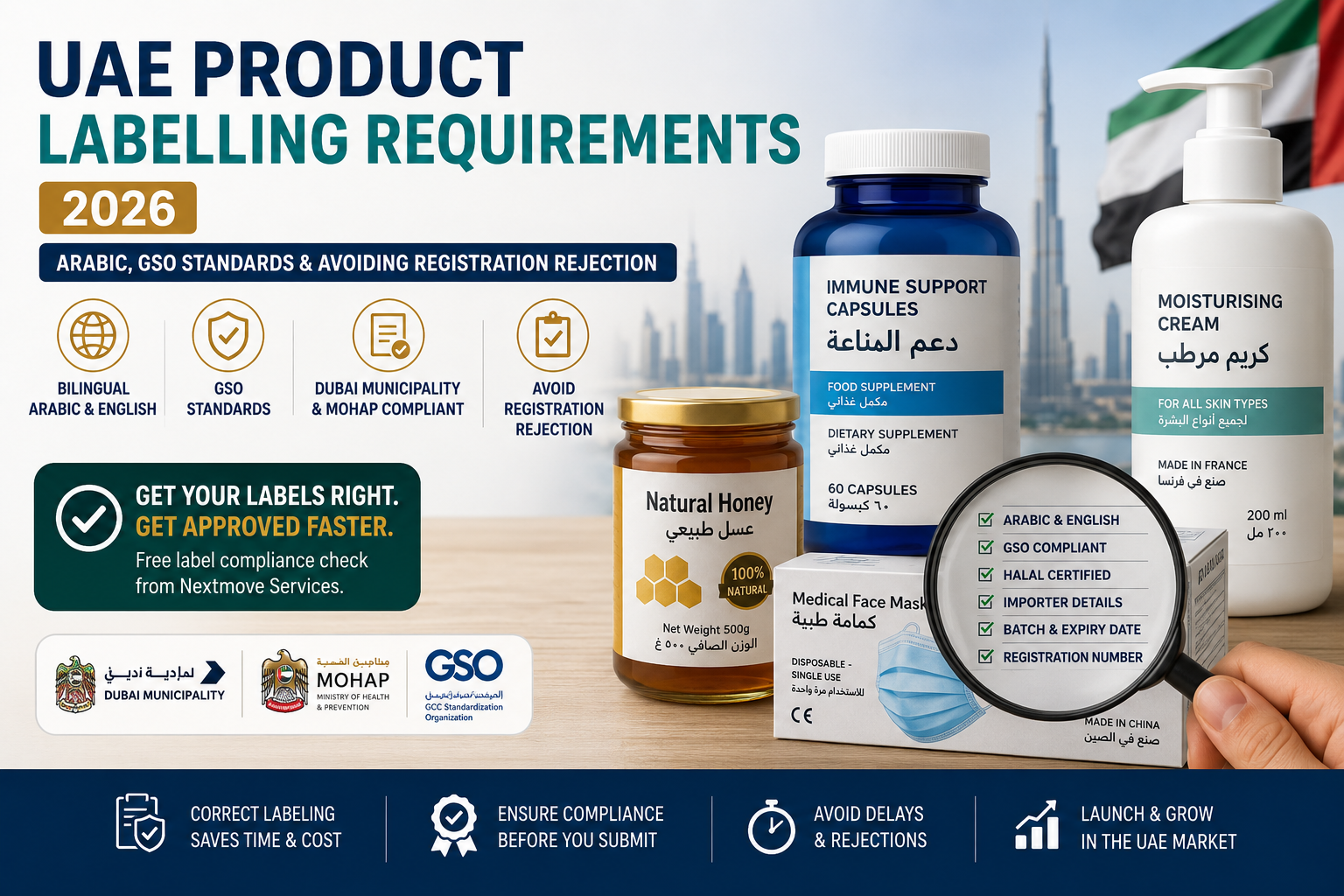
Product labelling compliance is the single most common reason UAE product registration applications are rejected or delayed at the first review stage. It is also one of the most preventable causes of rejection, because the requirements are clearly defined — they just need to be applied correctly before submission.
This guide covers every labelling requirement for products sold in the UAE in 2026: mandatory bilingual content, GSO standard specifications by product category, restricted claims, and the label approval process within Dubai Municipality and MOHAP workflows.
Why UAE Product Labelling Is Different
The UAE’s label requirements are not simply a translation exercise. They are a layered compliance system drawing from three separate frameworks: UAE Federal regulations, GCC Standardization Organization (GSO) standards, and authority-specific requirements from Dubai Municipality and MOHAP. Each layer can independently cause a rejection if not addressed.
Arabic is not optional or decorative. It must appear on the label with the same prominence as English text, correctly translated, and in a font size that is readable. Labels where Arabic is smaller or less prominent than English will fail compliance inspection.
Universal Mandatory Elements
Regardless of product category, every consumer product sold in the UAE must include all of the following on its label:
| Mandatory Element | Language | Notes |
|---|---|---|
| Product name | Arabic + English | Must match registration certificate exactly |
| Brand / trade name | Arabic + English | Transliteration acceptable for Arabic brand names |
| Country of manufacture | Arabic + English | Must match import documents |
| Importer/distributor name & UAE address | Arabic + English | Must be UAE mainland-licenced entity |
| Net weight / volume | Arabic + English | Metric units mandatory — imperial optional |
| Batch / lot number | Numeric | Mandatory for traceability |
| Manufacture & expiry date | Arabic or standard format | DD/MM/YYYY format standard in UAE |
| Storage conditions | Arabic + English | Mandatory for most regulated products |
| Registration / approval number | As issued | Added after registration — must appear on market labels |
Category-Specific Requirements
Food Products — Dubai Municipality / FIRS
- Full ingredient list in descending weight order — Arabic and English
- Allergen declaration using exact GSO-approved terminology (e.g. “Contains: milk, gluten, soy”)
- Nutritional information per 100g/100ml AND per serving — in Arabic and English
- Halal certification mark and certificate reference number (mandatory for all food products)
- Use-by or best-before date — format: DD/MM/YYYY
- EAN-13 barcode compatible with UAE retail scanner systems
Cosmetics & Personal Care — Dubai Municipality Montaji
- Full INCI ingredient list in descending concentration order (Latin names standard; Arabic translation not required for INCI names)
- Product function (e.g. “moisturising cream”) — Arabic and English
- Warning statements where applicable — Arabic and English mandatory
- Shelf life: “Best before” date OR Period After Opening (PAO) symbol
- SPF claims: value must be validated by laboratory test and stated on label
Health Supplements — MOHAP & Dubai Municipality
- Supplement facts panel — all active ingredients with amounts per serving in Arabic and English
- Recommended dosage and method of use — must match the clinical evidence in the registration dossier
- Mandatory disclaimer: “This product is not intended to diagnose, treat, cure, or prevent any disease” — both languages
- No therapeutic claims permitted unless registered as a medicine with MOHAP
- Halal certificate reference number mandatory
Medical Devices — MOHAP
- Intended use / indications — Arabic and English
- Contraindications and warnings — Arabic and English
- Single-use symbol per ISO 7000-1051 (if applicable)
- UDI (Unique Device Identification) — mandatory for Class II and above
- Manufacturer name and address — origin country
Common Rejection Causes — and How to Avoid Them
| Rejection Cause | How to Avoid |
|---|---|
| Arabic text too small or illegible | Minimum 1.5mm font height for Arabic — same size as English |
| UAE importer details missing | Confirm UAE distribution partner before any label artwork is finalised |
| Claims not matching registration dossier | All label claims must be supported by evidence in the submission dossier |
| Wrong ingredient nomenclature | Use INCI for cosmetics; GSO-approved terminology for food allergens |
| Missing halal certificate number | Never finalise food or supplement label artwork without confirmed halal certificate |
| Expiry format non-compliant | Use DD/MM/YYYY consistently — US format (MM/DD/YYYY) is not accepted |
| Registration number not on market label | Registration number space must be built into label design — added after approval |